
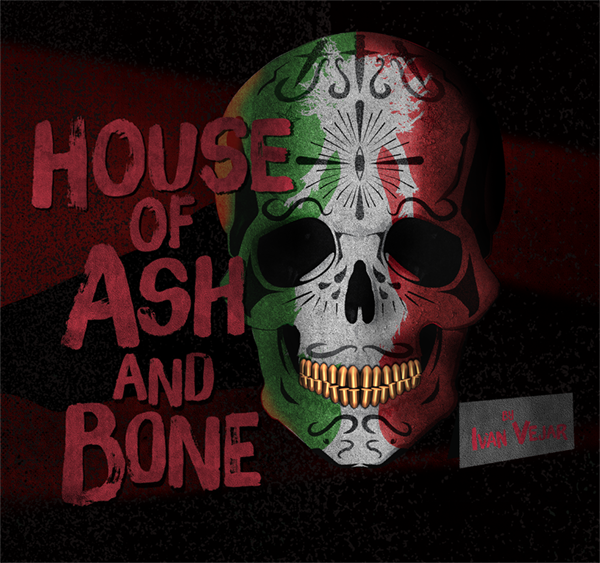
House of Ash and Bone Cover Concept
Guajolote que se sale del corral, termina en mole.
Chapter 1: April 13, 1984
“Wetback? Hey, wetback!” Rusty’s voice calls out, echoing in the alley. “You think you can hide from me?”
“No. No. No.” I whisper, crouching behind a large metal dumpster.
“You really shouldn’t have been talking to that cheerleader in that store. You might get your Mexican shit on her…What’s this? You dropped your bag, chickenshit.”
I hear him unzip my bag and throw its contents onto the asphalt.
“You don’t need this.”
Pencils fly, zinging in front of me, clinking on the metal walls of the large bin between us. Paper tears.
“Who needs textbooks, right? You sure don’t.” My textbook hits the dumpster’s edge in front of me, breaking in two. “I never even open mine.”Rusty laughs.
He pulls out some papers.
“Salem Hospital… Susana Garcia… encep… brain… critical…Boring,” he says then tears the document.
She’s dying.
“Oh wait! What is this?” Rusty says with a howl.“Holy shit, really… you keep a diary, like a girl.”
“Not that, please,” I whisper.
“Hope there’s some juicy stuff in here,” Rusty says.
Pages turn, then tear. A sheet of paper falls to the ground.
“Oh, my mommy’s sick… I miss her so much… ariba, ariba,” he says.
Another page turns.
My head spins. I press my palms into my eyes.
“Haha, is it cancer? Is she bald? I want my mommy… scared of the dark too… ghosts! Holy shit, what a wuss!”
As I open my eyes, a shadow moves across the wall in front of me. Wide, wild-black eyes stare back from the dark mass, looking at me, angry. A wide mouth-like gap opens under them, and I hear a distant woman’s scream, then my name echoes through the alley, first from far away then bouncing off the walls, getting louder and louder…
“Not again!” I think as I squeeze my eyes shut at tight as I can.
“Diego!” The woman’s voice rings in my ears, pounding in my head. I peer out, as a shadow extends from the gap, and five fingers form at the end. The black shadow hand extends toward me, grabbing violently at the air in front of me.
My feet push hard, slipping against the ground, as if trying to force my body into the wall behind me, tears, snot running down my face. I press my hand against my mouth to keep from screaming.
“Please stop!” I shout as I throw my hands over my ears.
“Nah, this is too good,” Rusty says, tearing out another page, wadding it up and throwing it in my direction. “Ooh, a story. Is this guy supposed to be you? What a fag!”
I bring my hands down and listen for her. Nothing. I open my eyes, and the shadow’s gone. My body shakes uncontrollably.
Another rip. He balls this one up and throws it over the dumpster, hitting me in the head.
“‘The gassy bully with his long red hair…’ Is this…me?” He pauses and turns the page. “Oh, man.”
“Diego,” the voice calls again, but from far away.
Another page turns.
“Oh, man…” Rusty’s voice serious.
“Diego,” that voice still further away. My teeth chatter.
Another page turns.
“Shithead, do you want to do this to me?” The voice says, then pounds on the dumpster wall. “You think you can write about me and get away with it, you little shit?”
“Please stop.” I say in a whimper.
Footsteps start toward me, and I feel the tears streaming down my face.
From behind the dumpster, a red-faced Rusty Grady steps in front of me, my creased journal dangling at the end of a long, farm-honed arm, flexing beneath the sleeves of a Van Halen t-shirt. The wind ruffles his orange blow-dried hair. His face otherworldly wrinkled like an old man’s, eyes glowing bright red, melting down his face.
“A La Tumba,” his mouth utters in a grizzled old man’s voice.
My arms fly up over my head as he throws my journal at my head, scraping a gash into my forearm.
“Russell! What the hell you doing, boy?” An angry man’s voice echoes from behind the dumpster.
“Nothin’, Pa.” Rushy says,
“Get the hell over here.”
“Yes, sir,” He says toward the other voice. “You wait right here, wetback. We’re not finished,” he whispers to me.
The footsteps fade down the alley, and a slapping sound cracks.
“I told you to stay put, you lousy no-good piece of shit.”
“Sorry, sir,” Rusty says.
I listen for his voice. Shaking, I look past the dumpster into the alley in their direction. Seeing nothing, I grab my bag, stuff what I can into it, and run across the street, hoping he doesn’t see me.
I run up Commercial Street, wiping my face, and head for the library, putting distance between Rusty and I.
When I reach the library, I hurry through the doors and head upstairs to hide.
Out of breath, I scan for him outside. I step back from the window and bump into someone, their books scatter on the ground.
“Sorry.” I say, still trying to catch my breath, still keeping a worried eye on the window.
“Cuidado, muchacho.” A pleasant voice startles me, and I turn toward it. An old man dressed in a dark gray suit smiles at me, a few teeth missing from his grin. His eyes, deeply set and dark, smile kindly. The hair on his head, sparse and disheveled. Wrinkles on his thin, deepen as his smile shifts and grows.
“Me puedes ayudar, por favor?” the old man says, adjusting his tie, pointing to the books on the floor.
“I’m sorry, I don’t speak…”
“You don’t speak Spanish, young man?”
“No…I don’t.” I say, my voice wavering.
“Well, you should remedy that,” he says, taking a seat by the window. “Would you be so kind as to help me?” he points to the book on the floor.
I hesitate.
“You have had some trouble?” He points to my arm, and hands me a handkerchief. “Are you all right, young man?”
Slowly nodding my head, a wipe my arm and bend down to help him with his books.
I read the titles as I stack them on a chair: A Grief Observed, Heart of Darkness, On a Pale Horse, A Death in the Family.
“Death in the Family,” I whisper under my breath, and shiver.
The man pulls out a pocket watch, looks at its face and then nods his head.
“Sorry about that,” I say again as I place the last book on the stack.
He smiles, his eyes scanning the shelves of books around him, putting the watch back into a breast pocket. “Always think I have more time than I do.”
I glance out the window.
“Son,” I turn to him. “Sit.” He motions for me to sit next to him as he gently grabs my arm, the red scrape starting to bruise, his hands, ice cold.
“It hurts, I know, but this will heal.” He lets go and pats my knee. “Sometimes injuries are so deep, people pass them along to the next generation.”
He sees the confusion on my face.
“Some wounds reach out… reach out to be heard, to be remembered.” His eyes look out the window.
I put my hand over my scrape as my body quivers. He peers into my eyes.
“There no reason to fear. No one hides from Death.”
“My mom…” I say, unthinking, regretting my slip.
He rises, grips my shoulder.
“You, Diego, still have a journey ahead of you,”he walks away, waving his hand as he walks. “Susana’s story is at an end,” he says as he turns the corner.
“I never told you my mother’s name,” I say, looking down at the stack of books lying on the bench. “I never told him my name!”
“Hey!” I call out. “Hey, who are you?” I run to the end of the shelf. I run across the aisles. There’s no trace of him. I turn and look down. A book lies in front of me: Macario.
Chapter 2: April 14, 1984
“Are you all right, Diego?” Richard says, eying me from the rear-view mirror, as Mrs. Landry turns to me from the passenger seat. Charlie, their four-year-old, sleeps on the floorboard behind her.
“I’m okay.” I turn away from Mrs. Landry’s gaze. “My mom isn’t getting better.”
“Man, I’m so sorry, Diego,” Richard says.
Richard Landry is a friendly man with a modest smile, for “Folks deserving of my hospitality,” he once told me with a Louisiana drawl. Once you get into his circle of trust, his warmth, his strength, is earnestly given. A thin man, with a sadness around his eyes, and a fierce protective nature, always in one of his many brown velour, short-sleeve, button-up shirts and maroon corduroy pants, “my signature color, son,” he once said to me.
I raise my hand and run it through my hair.
“What’s that on your arm?” Richard says, his eyes wide in the rearview mirror.
I lower my arm, placing my hand over the bruise.
“I fell.”
“Arm? Diego?” Mrs. Landry says, worry on her brow.
“I fell yesterday; it’s fine,” I say, rubbing it to block the bruise from her vision.
Mrs. Landry reaches over her seat and grabs my arm, pulling it up and away from my grip.
“Oh Lord! What is this?”
“Nothing. Just a little bruise. I fell yesterday on my way to the library.”
Richard narrows his eyes in the mirror.
“Did you ice it? Boy, this looks awful!” Mrs. Landry says.
“No, it’s fine, doesn’t hurt at all.”
“We’re here for you, you know that, right?” Richard says.
“I know.” I pause, hesitating, looking away from Richard’s eyes staring back from the mirror.
Mrs. Landry lets go of my arm and screws up her face, her glare trying to force me to tell her what happened.
“Really. I’m good.”
“M-hm,” Mrs. Landry says, her eyes boring into me, expecting an answer.
I nod my head as I glance at Richard, still measuring me up in the mirror.
“Have the doctor check that.” Mrs. Landry says.
“I will.”
Mrs Landry sits back in her seat and puts her hand on Richard’s leg. Richard drops his hand from the steering wheel and places it on hers.
“You know, Diego, my mother’s been really sick for a while too,” Mrs. Landry says, as Richard squeezes her hand. “I feel horrible about telling you this, but I… we need to go back and take care of her.”
“I understand.” I look out my window and sigh.
“If we could, we would take you with us, but we don’t have the legal power to do it, or the money to fight for it, if… If your momma dies, Diego.”
I sigh.
“How soon do you plan on leaving?” I ask.
“Not sure.” Richard replies. “We legally have one more month to take care of you, then your social worker says she will have to take and put you into foster care. This is all so shitty.”
“Richard! Language,” Mrs. Landry says.
“Well, it is.” Richard says.
“It is.” I say under my breath.
“I don’t mean to pry, Diego, but what did the social worker say?” Mrs. Landry asks.
“She told me what will happen after the power of attorney expires, that I will have to ‘go to a home, and wait for the outcome of your mother’s condition.’” I say in a mocking tone.
“She said that… like that?” Richard says, looking at me through the rearview mirror, and I nod. “Shit.” He shakes his head, and Mrs. Landry lightly slaps him on the shoulder.
After a long silence, Mrs. Landry bends to look at her son.
“I’m so sorry, Diego,” Mrs. Landry says, placing her hand on my knee. “In a few years, you can come to Louisiana and live with us. You always have a home with us, you know that.”
“I know.” I say as my eyes well up.
Mrs. Landry gently squeezes my knee and turns around in her seat. I see her raise her hand to her face, and Richard reaches out and puts his hand on her cheek.
“I’m sorry, son,” the doctor says as he tightens his grip on my shoulder. Richard’s strong hand clamps around my arm, Mrs. Landry walks out of the room with a sleeping Charlie in her arms. “She is comfortable, I promise, but the inevitable is coming, son. Nothing more we can do for her but wait.”
He paused and cleared his throat.
This is never easy…,” he says. “Don’t know if she will regain consciousness before… before her passing. The brain swelling is too much, and we can’t get it under control. Her system is failing quickly. No one can say what she hears, what she understands. Let her know you will fight on, that you will not give up.”
I am empty… nothing.
“I, I will.” I say, not grasping the severity of his suggestion.
“Your social worker is downstairs and would like to speak to you when you have a moment, Diego. They need to make sure you are taken care of after… you know,” the doctor says, squeezes my shoulder, and walks away.
I nod.
As I walked toward my mother’s room, Richard says he needs to get a snack for Charlie and walks toward the elevator. They always have snacks in Mrs. Landry’s purse, but I say nothing. I need to speak to Mom alone.
As I walk into the room, a nurse removes the thin hospital blankets and another checks Mom’s vitals on the machines.
“Mom?”
My mother’s eyes are open set deep into her face. Dark rings under her eyes age her far past her true age. The hair on her head is thinning. Her skin is pale and looks paper thin, a network of blue veins protrudes from her arms and legs. Her mouth, slightly blue.
“Mom?”
“Son, what do you want in life?” She once asked me while we were reading in the living room together.
I shrugged my shoulders.
“You must want something. How bout becoming a doctor?”
“I’ve told you I’m not good around blood, Mom. How can I be a doctor when blood makes me queasy?” I replied, a serious expression on my face.
“You had a bloody nose last week, and you were fine with that.”
“Mom, that was my blood. I can’t stand other people’s blood.”
“Maybe all good doctors have to learn to be around other people’s blood, Diego.”
“Drop it, Mom. Even if blood wasn’t a problem, we can’t afford what... ten years college.” I said with a serious face, but with a soft smile to let my mother down easily.
Even if we had the money. Even if I had a full scholarship, I wouldn’t want to waste so much money trying to find out that was what I wanted to do with my life.
Why can’t I know? Just an idea so that I can reassure my mom. Let her know that I have a plan… that I will be okay? I’m letting her down.
Breathe.
We had our entire lives ahead of us. She would see me walk at graduation, meet my first girlfriend and embarrass me by telling her all the silly things I did growing up. She would cry at my wedding, be there for her grandchildren, be there for it all. Now, she is dying. She will die.
“Son, we need to have a serious conversation.” My mother recently said as she sat at the dining room table. Her hand reached out, asking me to sit. “I want to talk to you about something important. I hope that this is still a long way from now,” she put her hand on my knee, “but in less than two years you will be out of school. You will begin your own life, without me, and you and I need to be clear with what my wishes are in case... in case something happens to me.” Her face serious.
“What do you mean?”
“Diego, you need to know what I want done if I die.”
“Mom, do we need to talk about this now?”
“Yes... yes, we do. It would be good for you to be prepared with… with what I want.”
I couldn’t look at her. I didn’t want to imagine her dead.
“Don’t bury me. Don’t put me in a coffin, don’t put me in the ground.”
“Mom, I don’t think we need…”
“Diego, listen. I want to be… burned. What do you call it?”
“Cremated?”
“Yes, cremated. I want you to cremate me. I don’t want a ‘resting place.’ When we die, that body is no longer us; it’s just a container. I don’t want to be someplace where you have to come visit me. It won’t be me. Do you understand?”
“I... I.”
My mother gently grabbed my chin and peered into my eyes, trying to see if what she said stuck. As though she could see it by looking in my eyes.
“Remember my wishes, whatever happens. You don’t need to visit me; I will not be there anymore.”
Still holding my chin, her other hand points between my eyes.
“I will be here,” she points to my chest, “and here. I will be with you wherever you go, my beautiful boy. Do you understand?”
What can I say? I nodded yes.
I can’t handle this right now.
The nurses place fresh linens on my mother, and then one opens the curtains. A ray of sunlight falls on my mother’s forearm, reflecting brightly on her skin, making it seem paler than it was before. They tuck in the blankets below the mattress and look over to me with a sympathetic smile. I nod back.
“Mom, I love you.”
Chapter 3: April 14, 1984
I lay in my bed staring up at the black ceiling.
Turning onto my side, I read the clock on my nightstand. 2:36am.
Getting up from my bed, I walk to the kitchen and pour myself a glass of water. A train horn honks outside. My hand trembles, lukewarm water spills on my shirt as I drink.
We live on the second floor of a drab, brown apartment complex literally on the wrong side of the tracks. When you're right next to the tracks, both sides are on the wrong side.
We’ve grown used to the grinding roar of the train passing at all hours, the lights shining through our windows when it comes at night; the horn warning the neighbors of its presence.
I sit on the sofa and put the glass on the end table. I stare at it as my mind fades. A sudden wave of weariness washes over me, lulling me, taking me away. While strange voices echo from somewhere far away.
I float through a black passageway lit by a dim orange light from above. Inky shadows with glowing red eyes wriggle toward me, a thick, blood-red liquid slowly dripping from them, under them, as they draw closer. I fall on my back, and the eyes gather above me, looking down, mocking me.
Dragged, I struggle; my hands and feet can’t move. I’m trying to scream, but my mouth doesn’t open. We stop at a set of doors. My body lifted and pressed hard against them. In front of my face, ragged, grinning teeth glowing dimly below red eyes. A polished blade, reflecting the unearthly light from those eyes, pressed into my cheek.
The room fades into blackness.
An orange bulb fades on, and a painful sensation of tearing skin from the straps wrapped around my wrists and ankles. In front of me, the eyes stare back, now blazing bright red. Trails of red vapor float above them as they sneer at me.
“Diego,” a raspy female voice calls out in the darkness.
“What do you want?” I scream.
“Diego.”
“Who are…”
A gray shape appears inches from my eyes. A face with no eyes. Its skin a living ash, undulating in and out of every pore.
“Diego.”
I squeeze my eyes shut, my hands pressing hard against my ears.
Stop!
A flash of white shocks me into closing my eyes.
I find myself on all fours on the living room floor.
“Diego.” echoes through my head.
I jump from my spot, unsteady on my feet, the daylight outside burning slivers in the curtains.
I rub my eyes, trying to remove her face from my memory.
The light coming through the curtains catches my attention, I run into my room and look at the clock. 8:05am. Damn, I’m late.
“Pop Quiz!” our teacher says to a groaning classroom.
My English teacher, Mrs. Mildred Easley, a middle-aged, thin-lipped woman with a bun so tight on her head, her eyes pull back at the ends, writes questions on the chalkboard.
“You will have five minutes to answer these five questions about your reading from last night. I expect you all to be quiet.” She turns to the students. “Eyes on your own papers.”
The class erupts with the sounds of paper tearing out of notebooks, pencils shifting onto and across desks.
Mrs. Easley sits at her desk and looks at the clock.
“You may start now.” She glares at me and then looks around the class.
I’ve had a tough time reading Romeo and Juliet between visits with my mom. Everyone knows the end. What happens to the lovers. I don’t need reminders of her situation from school assignments too.
I quickly finished the quiz and stared out the window, thinking about the dreams I’d been having. They are like a scene from a movie playing over and over in my head. That voice.
“Diego Garcia, why are you not working on your quiz!” Mrs. Easley glares, her face turns red, as the class laughs. She walks over to my desk and snatches my quiz from my desk.
“Are you deaf? Can you not hear me calling your name for the last two minutes? I’m giving you a zero for this quiz! We here have expectations and standards!”
A student giggles.
She writes a note to the principal, on pink paper, as I gather my stuff.
“Take this and get out of my classroom!” She holds out her outstretched arm, the pink slip crumpled in her grip.
The students snicker behind me as I take the pink slip and walk out the door with my head hung low.
“So, my boy, what do you have to say for yourself?” Says a voice from behind a door.
Sitting on a yellow built-in bench next to a frosted-glass door with “James A. Crumbly, Principal” painted on it, I listen to a conversation on the other side of the door. The waiting room is empty except for me and the two people in the principal’s office. In front of me, a large painting of the Oregon Pioneer, a gold man, a heroic, axe-wielding guy leisurely standing on the dome above the capitol building, his coat slung over his shoulder, the model for all rugged, Oregonian men.
“Mr. Crumbly, working on the farm yesterday really tuckered me out. I’m sorry. I didn’t mean to throw the textbook at Mr. Jenkins. It was an accident,” a familiar voice responds.
“Your dad and I are excellent friends, you know that. He would be very disappointed in what you did today. You already have detention for the rest of the week.”
“I’ll never do that again, I promise.”
“Well, all right, Rusty. I’ll let it go this one time.” Crumbly says with a chuckle behind the door. .“You really clocked him good, my boy.”
Rusty?
The door opens and out comes Rusty Grady. As he walks out, his eyes catch mine. He puckers his lips and winks his eye.
“Dead-eggo,” he whispers loud enough for only me to hear.
“Boys will be boys.” Crumbly says under his breath. “Rusty, is there anyone else out there waiting for me?”
“Yes, sir,” He says, glaring at me, then punches me in the shoulder. “Go on in.”
“What’s going on, Diego?” my principal, Mr. Crumbly, a 35-year veteran of Salem High School, asks from behind a worn-out heavy wooden desk. A white crew cut, always trimmed to perfection, crowns his head right above a stern NASA engineer face. The thick black-rimmed BuddyHolly glasses that have dug deep grooves into the bridge of his nose and the side of his head after forty years, frame his eyes as he reads the slip from my teacher.
“It says here you were disturbing the class?”
With my eyes downcast, I shrug my shoulders.
“You’re a model student here, Diego.”
My finger flips the zipper on my bag as he waits for a response.
“What do you have to say for yourself?”
“I didn’t do anything.”
“Well, what am I to do with this? Who do I believe?” Crumbly holds up the pink slip of paper, waving it below his chin. “Mrs. Easley has been an exemplary teacher for over 25 years. Why would she say you did something if you didn’t do anything?”
“I didn’t do anything.” I repeat as I continue to look down.
“Listen, I know you’re going through a tough time right now, but that does not give you the right to interrupt our classes here.”
Mr. Crumbly pulls out a black-ringed notebook and writes something in it.
“You will do detention today after school with Mrs. Easley.” He writes a note on a slip of paper. “Then, detention every day for a week. I will let her know to expect you for the rest of the week.”
My eyes glance up at him and then down again.
“I don’t want to hear any more about this. You will not have a second chance. One more of these and I’m expelling you. Outstanding student or not, I don’t care what’s happening to you outside of this school. My responsibility is to the students of this fine institution, and no one student will hold me hostage with emotional outbursts in class.”
I flip my zipper one more time.
“Go back to class, give this to your teacher, and get out of my office, and I’m warning you, stay out!”
Walking through the halls, I consider leaving the school, never coming back. It would be so nice to leave my detention seat empty and have Mrs. Easley report back to Crumbly that I never showed up, that I disobeyed. The look on their faces would be priceless, but I’d never do that. I couldn’t break the rules and get in trouble on purpose. What would my mother say? I wouldn’t want to disappoint her. She’d understand this detention once I explained the problem, my daydreaming, but she wouldn’t excuse outright disobedience.
Rusty gets a slap on the wrist for throwing a book and breaking a teacher’s face, and I get threatened with expulsion for daydreaming. I know it’s not fair, but you get used to it. My mom and I have seen the glares when shopping at stores. We get stopped by the police downtown to ask what we are doing all the time. It’s the way it is here.
Detention.
I have detention for the first time.
Wait… Did Crumbly say Rusty has detention too?